Groove Attack, behind the sounds produced between the EU and the US.
If there is a phenomenon of considerable interest—and, above all, profitable—that has come to define a certain trajectory of Hip Hop in our time, it is the increasingly natural connection between European producers and labels with American emcees. Today it feels almost obvious. Files travel, stems bounce, and verses land in inboxes overnight.
It wasn’t always like this.
Twenty-five years ago, this kind of exchange was anything but immediate. There were objective limits—technology, distribution, access—but also a deeper issue: credibility.
Let’s be honest, Americans thought they were the only ones who could really do this thing. And for a long time, maybe they were right. Or at least, they owned the narrative.
Only later did that perception begin to crack, partly because the sound shifted. Partly because the U.S. hip-hop industry, at a certain point, folded into a more polished, more commercial —sometimes emptier— version of itself. The so-called “bling era” did not leave much room for the raw, the stubborn, the essential.
And in that space, quietly, almost off-radar, something else started happening.
A Shift You Barely Notice
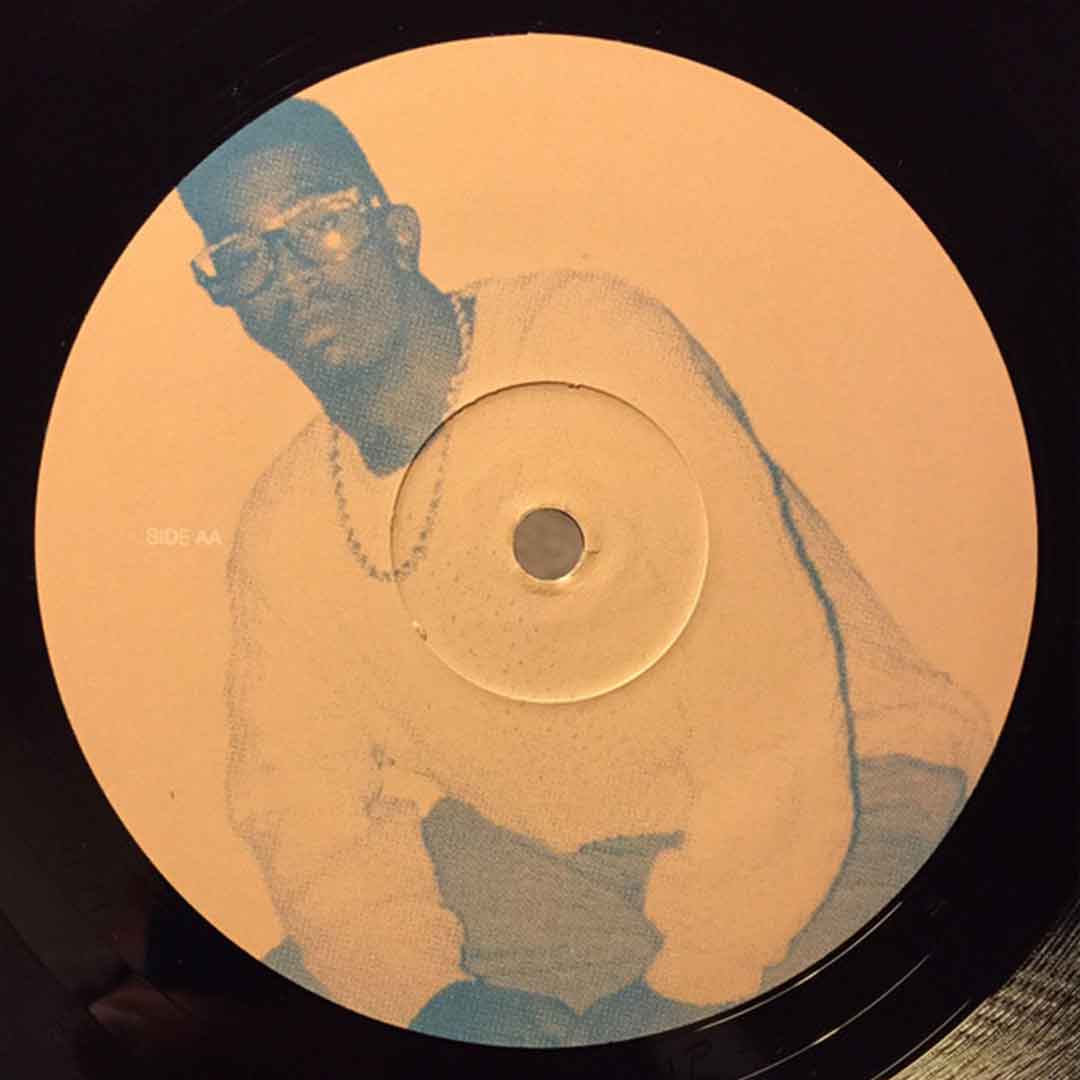
Between 1998 and 2000, a label appeared that would end up drawing a line, piece by piece, between a “before” and an “after”: Groove Attack Records, out of Cologne, Germany.
Not loudly. Not with declarations. But with choices. Originally born as a record shop, then evolving into a distribution imprint first, and finally a full-fledged record label, the imprint is still alive and kicking to this day, although focusing on different genres than hip-hop and urban music only.
First, they dropped a compilation that remains etched in memory: Superrappin’. A title that says exactly what it needs to say. Inside, European producers alongside sharp, uncompromising emcees, with a Canadian presence that only added texture to the whole. It wasn’t a statement, it was a signal.
Then came the move that shifted the perspective for real: releasing the solo album of Phife Dawg, one of the voices that had defined the very idea of Hip Hop as a group form through A Tribe Called Quest.
At that point, the axis moved.
From a single centre of gravity to something else. A polycentric map. Multiple points, multiple directions, same language.
This is the kind of change that happens in the background. You don’t notice it immediately. But once it settles, everything before feels different.
Germany, Quietly Holding It Down
At the time, Germany was living one of its strongest moments in terms of Hip Hop, especially rap music, even if the rest of the world wasn’t really paying attention. France had the spotlight: bigger records, stronger visibility, a scene already in dialogue with the U.S.
Germany moved differently.
Less visible, more open. More xenophilic, more Anglo-friendly. A perfect ground for circulation. Sounds could pass through, evolve, and travel again. Europe, Japan, back to the States—loops closing in unexpected ways.
In that moment, Groove Attack became a crossroads. A nerve centre.
Through scouting, connections, and a very precise sense of what mattered, the label brought forward a wave of raw, uncut styles: music that, in many cases, struggled to find space in its own country of origin.
Artists who were underdogs. Or veterans. Or simply overlooked.
A certain kind of sound found oxygen again.
When the Sound Changed
To understand why this mattered, you have to step back for a second.
By the end of the 1990s, something in Hip Hop had shifted. The tail end of the New York underground renaissance was fading. The run that had gone from the late ’80s to around 1997, almost uninterrupted, record after record, had reached saturation.
It was natural. Cyclical, somehow.
The second half of a decade has always been a breaking point across genres. Generational shifts, new aesthetics, market pressure. The disappearance of key independent labels —Rawkus Records, anyone?—didn’t help.
For those who were into the tougher, more essential side of things, it became harder to find music that felt right.
Digging was not easy. Especially in Europe, where the Internet was still a promise more than a tool. In Italy, it was borderline science fiction.
And yet, in that exact moment of scarcity, something precise emerged.
Quality, Stubbornness, Time
Let me think for a second—what more can be said about Groove Attack, other than what was already clear back then? A commercial policy synonymous with quality and stubbornness.
They weren’t chasing trends. They weren’t reacting. They were placing. Carefully. Consistently.
Good music that hit immediately when it came out, but also held up over time. First in a niche market. Then against the only metric that really matters: years passing, records staying.
This is, in brief, what Groove Attack built in the late ’90s and early 2000s.
A catalogue that didn’t need noise.
Names That Matter (Before They Exploded)
The list speaks for itself—and still doesn’t fully capture the scope.
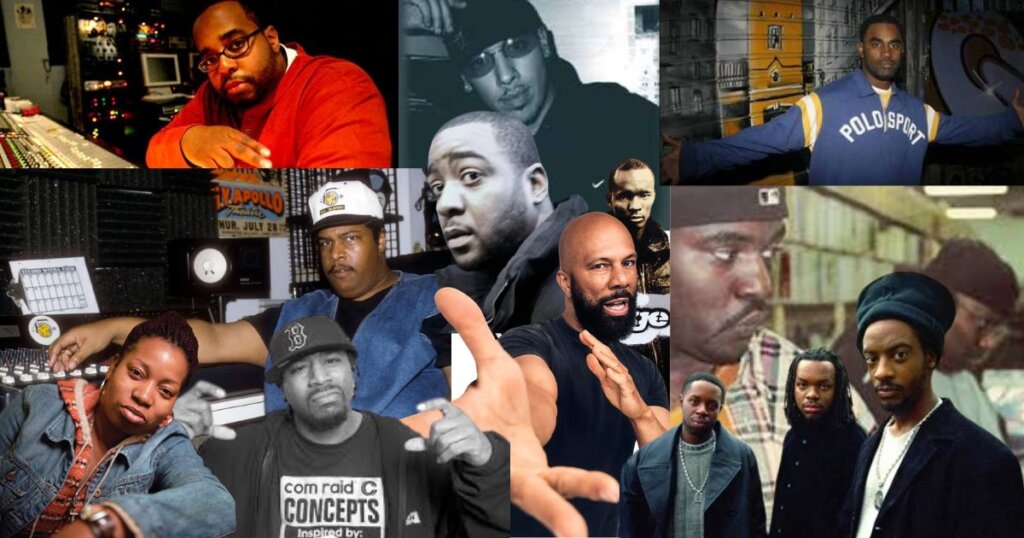
A young J Dilla—then still Jay Dee—released top material with Slum Village through Groove Attack before becoming a global reference point.
Madlib e Peanut Butter Wolf moved in the same orbit at a time when Stones Throw Records was still far from its later status.
The already mentioned Phife Dawg built his solo debut with the support of the Cologne label.
And then a wider constellation: Edo G, Bahamadia, Mark The 45 King, Common, DJ Spinna, J-Live, Lone Catalysts, and more.
Not a roster built for headlines. A roster built for listening.
The approach was clear: seriousness, creative freedom, minimal interference. Even visually: minimalist, contemporary graphics. No excess. Just enough. And it worked.
An international audience picked it up. Recognized it. Carried it forward.
Tapes, Sides, and What Stays
For many of us, it started with tapes. Real ones. Physical. Side A, Side B. Rewind, play, flip. Again.
This new episode moves exactly in that direction: a virtual mixtape in two parts, conceived shortly after Phife’s passing. Two sides of an imaginary cassette. A format that still makes sense, even now.
The first half set the tone, with the grittier sound aptly selected by TwoMave.
The B-side is soulful and funky, pieced together by FFiume.
A continuation, but also a closure.
This selection, curated personally and brought together with Jr Mastro e Dee Jay Park, with the support of TwoMave and the extended StrettoBlaster family, is not a reconstruction.
It’s a filter.
The flavour of that time passed through a personal lens. Names that connect with the first part, forming a full 60-minute monographic mixtape. Something you don’t just play, you step into.
These sounds don’t age. They sit there, intact. As if they were made today.
Big things.
Arrivederci.
Groove Attack Records Mixtape [ Hip- Hop Labels ]
Side A – selected by TwoMave
1 Audio/Visual – Bravo & Sandman
2 Betterthanbefore – Edo G. & Vinyl Reanimators
3 Reachin’ (For My People…) – Walkin’ Large
4 Dimmin’ The Life – L-Fudge
5 Dynomite – Lone Catalysts feat. J-Live
6 Nobody – Consequence, Shabaam Sahdeeq, Mike Zoot, F.T.
7 Grand Right Now (Paul Nice Rmx) – Grand Agent
8 Don’t Trip – Declaime feat. Quasimoto
9 Birds Of A Feather – J. Rawls feat. Top Emcees
10 Spread Love (Rmx) – Mike Zoot feat. Labba
Side B – selected by FFiume
1 Car Horn – Common & Mark The 45 King
2 Bend Ova – Phife Dawg
3 Great Live Caper (Part 1) – J Rawls feat. J-Live
4 How Many Xs – Rasco feat. Planet Asia
5 How You Love That – I.G. Off & Hazadous
6 Natruel On Top – Natruel
7 Relax, Relate, Release – Eddie Brock
8 The Movement – Declaime feat. The Lootpack
9 Truth in Position – Maspyke
10 The Look of Love (Original Version) – J-88
11 The Look of Love (Part 1) – J-88