It’s not NoveNove. It’s novenove. The detail matters. And it only truly matters to those who have the patience, or the will, or the awareness — or all of the above — to read it between the lines of a broader context.
In the ripples of the sound, for sure. In the subtext that runs underneath, unnoticed by the distracted. In what remains unsaid, yet speaks volumes to those who have ears to hear. Entire worlds are expressed there.
Presenting novenove is no easy task, but precisely for that reason, a welcome one — especially in times of copy-paste press releases written by AIs trained to imitate imitation, to reduce the margin of error, and so on.
From a creative undergrowth rich with ferment, like the Italian scene of recent years, from the mental ghettos of the provinces, comes a producer I’ve been following for a while with curiosity.
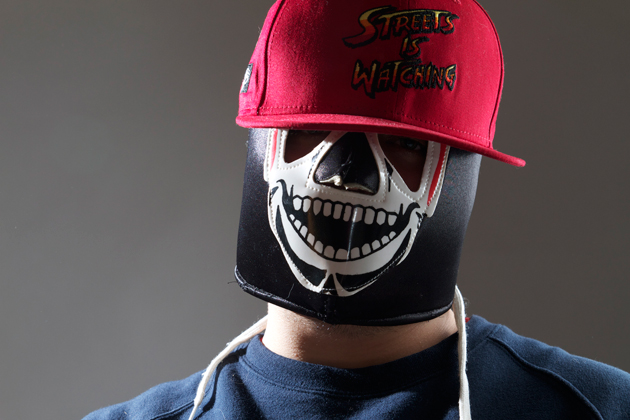
The scarcity of information about the man, paired with the unwillingness to present his face, matched with the abundance of music he’s produced in recent years — partly out of expressive necessity, partly as a way to soften the weight of a far-from-simple historical moment — has kept that curiosity intact, and the listening sharp.
After several releases which, to my personal taste, have been more or less successful, yet always musically compelling, the latest one hit the mark — and pushed that curiosity to the next level: deeper inquiry.
After receiving the press kit for Ghiaccio Blu, the latest release by Horror Tiberino and novenove, listening to the record closely, and noting with pleasure that no AI was misused to write nonsense (I’ll accept nonsense too, but only if it comes from a human hand, let’s be clear),
I set up a call with the elusive producer based in Città di Castello, Italy, to understand what moves the sky of the mind behind one of the most gracefully funk-leaning products made in Italy that the SB editorial desk has received in at least the past five years.
Ladies and gentlemen, please enjoy the reading.
In three words, for those who don’t know him, who is novenove?
Chocolate, bitterness, and funk…behind the scenes.
Where does your musical journey begin?
Very young — I was around 14 or 15. I came across hip-hop almost by chance: I bought La Morte dei Miracoli da Frankie Hi-NRG MC. Then I found out he was based in Città di Castello, basically right behind my house, even though he was originally from Turin. Quelli che ben pensano was on heavy rotation on TV, and both the video and the message completely blew me away.
His lyrics, for a middle school kid, were anything but simple. But you could immediately feel the depth, and it hooked me. I wore that record out, listening to it over the years and discovering new nuances every time. I could map Frankie’s stories onto the province I was living in — and that stuck with me.
From there, I started writing, like all kids do when they feel the need to say something. But I didn’t have beats. The internet was just starting in our country — you didn’t know where to look for instrumentals, and often they didn’t even exist. So I figured I could do it myself, using a computer. I started with Fruity Loops, putting together my first ideas.
Over time, I got into it: I began making beats for friends, once I discovered some of them were into this too. At the beginning, I was completely on my own, with no older brothers or “mentors” as references. I learned everything by myself. Then I met other people with the same “disease,” moved from machines to digital, then to a hybrid setup. That’s how it all started.
I produced for myself — yes, I also have a past life as a rapper — and at times for others, too. It was the early 2000s: we listened to everything, from hip-hop to indie rock. We had a band, kind of like The Roots — a mix of live instruments and vocals. We started more on the funk side, then shifted toward sounds influenced — with all the necessary caution — by Rage Against the Machine and Radiohead. Never reaching those levels, obviously, but that was the horizon.
I’ve always been someone who listens to music across the board.

What’s the first production you released or placed commercially?
Crash Test with Barra1. I had this beat and started looking for someone locally who wanted to work on it, but I couldn’t find anyone really interested. Then I met Barra1 — he got hyped immediately.
We met and made the track together. It all happened during a very particular personal period, which strengthened my connection to that piece.
I have huge respect for Barra. It was an important imprint: I came from nowhere, nobody knew who I was, and he — who had already done things, even with Esa — gave me total trust. No questions asked, only what he felt mattered. For someone coming from the province, where everything is more closed, it was almost disorienting. But powerful.
That’s why we made another project together, Sottocassa: I had beats that I knew could work for him. We worked on it for a long time, with pauses and other projects in between, but in the end, it came out because we both really cared about it.
Since you started producing, how long did it take before you made something you were satisfied with?
Honestly? It still hasn’t happened. Every time I listen back to something, I think: “not bad… but I could’ve done better.”
It’s an ongoing challenge with myself. It’s not so much technical — it’s more expressive: “I wanted to say this in a certain way, I didn’t manage, I’ll try better next time.”
Total satisfaction doesn’t exist. It’s always a work in progress.
And for me, it’s also a driver: I like discovering new things, stepping out of my comfort zone. When you find a formula that works, the temptation is to repeat it. I try to do things I don’t know how to do. If I had to keep repeating myself, I’d probably stop.
What do you listen to today? Where do your inspirations come from?
Funk is home. The whole world of George Clinton, Bootsy Collins, Parliament-Funkadelic — that’s a deep root, and maybe you can hear it in Ghiaccio Blu.
Then I go into jazz as well. I was lucky to have a musician friend, a double bass player, who opened that world for me. I listen to the classics: John Coltrane, Thelonious Monk, Bill Evans. But also more modern artists like Immanuel Wilkins and Theo Croker.
One of my absolute references is Flying Lotus — genius, recognisable, out of scale.
Then Knxwledge — underrated, but with an unmistakable groove — and Kaytranada, who really opened my mind with that mix of dance and funk.
I also had a strong electronic phase — Daft Punk, for example, had a big impact on me.
I’m not a musician in the classical sense: I play by ear. But I work a lot on sound, on synths, on plugins. And especially on bass: for me, it’s a narrative instrument. It shouldn’t just fill space; it has to say something. That’s why I’ve always loved G-funk, like Dr Dre — the bass leads, it doesn’t accompany.
What’s your production setup?
It depends on what I need to do, but I almost always start from a sample.
I work a lot on the SP-404: I chop, loop, dirty it up, and even destroy it if needed. I don’t like things that are too clean.
Then I decide: either I continue there, even drumless, or I move into Ableton and build drums and arrangements. Typically, I play on the SP and arrange in Ableton.
Digging in the crates for records: yes or no?
Absolutely yes. Not out of fetishism — I just like listening to records. Then, if I find something interesting, I note it down. I also go to flea markets: Sunday mornings, digging through weird stuff is part of the game.
Best digging advice you’ve ever received?
None, really. I’ve always done it my own way.
But once someone told me: go on Discogs, find who worked behind the scenes on a record you like and follow that trail. From there, you discover insane things. And it’s true.
A recent find that stuck with you?
The soundtrack of Sapore di Mare. It was given to me as a joke by Giovanni Normale, my partner and art director in Horror Tiberino. He bought it almost jokingly at a flea market, saying he thought I’d find something in it.
Then at home, listening with my wife, that masterpiece started playing — Mi sono innamorato di te by Luigi Tenco, reinterpreted by Ornella Vanoni — which everyone knows, but on that vinyl soundtrack it’s a third version I personally didn’t know. And there’s an incredible loop in there.
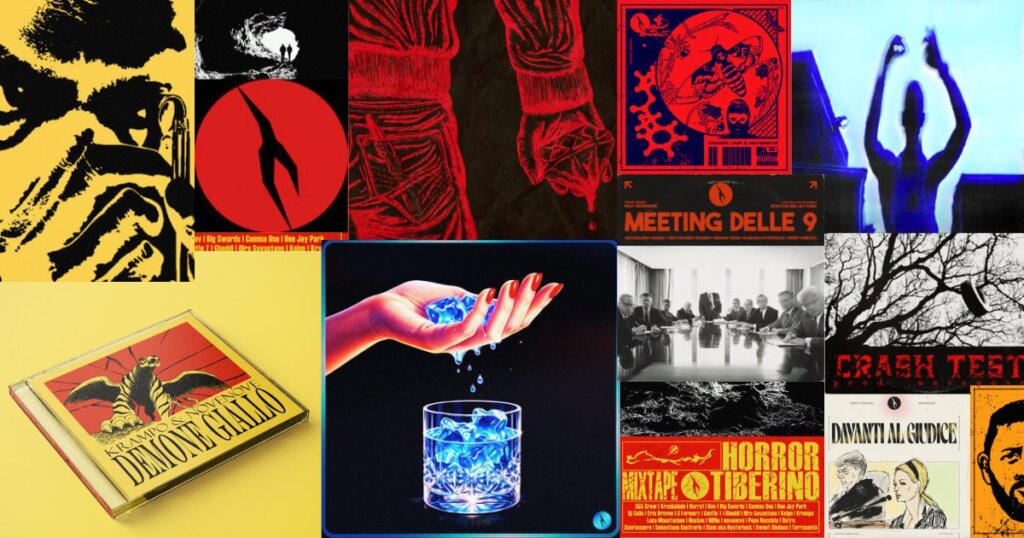
I made a beat out of it: it became Battuta di caccia by Comanche Hooks, Butch and Hiro Savastano.
Sometimes the best things come like that — Sunday morning after breakfast.
What is Horror Tiberino?
It’s a container.
A place where we can do whatever we want, simply put. It wasn’t born as a label, even though sometimes it behaves like one. It’s not just curation. It’s an open space for strange, lateral, not very commercial ideas.
Anyone with a similar vision can step in and build something together with Giovanni and me.
And it also comes from the need to exorcise something typical of the province: self-referentiality.
In 2026, it makes no sense to stay closed in your own enclosure. You can connect with anyone, anywhere.
An artist or producer who made you think “Oh, sh-, I need to get back on the machines”?
Kenny Segal, especially on the album Maps with Billy Woods.
Arrangement-wise, it hit me hard: very dynamic use of samples, almost chaotic but controlled.
And JPEGMAFIA — things I wish I could do, but can’t.
Your worst production mistake?
Pretty much everything. I’m very critical of what I do.
Sometimes, listening back, I think I pushed certain kicks too much. Other times too little. Nerd details, but they stick in my head. It’s a constant adjustment: you try, you mess up, you correct. You never arrive.
Un consiglio essenziale per la miscelazione?
The ones I always tell myself.
Technically: don’t start with plugins.
First, make everything sound good with levels and balance, even in mono. Then intervene.
Artistically: don’t over-mix.
If something works, it works.
There are examples — like the whole Griselda Records universe — that sound “dirty,” even badly mixed, but created a new aesthetic. The idea matters more than perfection.
Dopo Ghiaccio Blu, what should we expect from Horror Tiberino?
Concrete projects are coming: I’m already mixing the next one, with rappers.
Then there will be things not produced by me, others more embryonic but alive.
And we want to work more on instrumental projects as well.
There are many ideas, some still raw. But everything is moving.
Free message.
Have fun. With music, first of all.
Listening recommendations?
The latest by Flying Lotus is worth it.
It’s weird, but I liked it.
Lately, I’ve been going back to older stuff more than new releases.
But FlyLo, for me, could just tap on a table — I’d still listen.