Hip-Hop is never boring if seen from the countryside
The multiplication of rap stylistics in contemporary society – post-internet, algorithmic, hyper-produced – has led to results that are, at best, uneven.
In most cases, the outcome is far less interesting than it would like to appear. Flat, when observed with even a minimum of historical perspective. Identical to a thousand others, lacking any distinctive traits of its own, more interested in replicating a code than actually shifting it.
And yet, for several non-digital-native generations, the approach to hip-hop culture — and to rap in particular — came precisely from there: from the originality of form, from the freedom of content, from sonic research, from the possibility of communicating in a non-orthodox way.
Maybe that’s also why so many people today struggle to find material genuinely worth their ears, except for those happy enough with yet another copy of a copy of Griselda.
That said, today we bring you a small example dangerously displaced toward the opposite end of the modern national-popular hip-hop spectrum.
To enter the journey, all you need is a grandmother’s checkered blanket, a pair of binoculars, and some earbuds.
Riding jazzy beats and soulful grooves, you move from the drug-dealing square that so many still declaim to a hill. A sort of reassuring, crooked daisy age made of birdwatching, province, suffering, redemption, and personal research.
Does it all sound too good to be true?
Maybe that’s because you don’t know Pepe Nocciola.
All good. What is a Marileno?
Good question. I think about it all the time, constantly. I don’t know what a Marileno is. A Marileno is a Marileno. A village guy, but I don’t know; it’s genuinely hard to explain. It has almost become an adjective, a way of doing things: “that track is Marileno,” “what a Marileno outfit.” I don’t know.
I mean: now I’m doing a video interview with a pimple in the middle of my forehead, so I’m really a Marileno.
It all obviously starts from my little village, where there’s this masculine version of the name Marilena. To me, Marilena really sounds like the name of a countryside lady from a small village.
Around here, I’d never heard Marileno used in the masculine, but it carries the idea. I imagine someone in a long floral dress, in the kitchen, cooking, then going out, taking a little walk through the village, buying bread. And that’s it, I’m a Marileno. It’s a very broad concept, but in the end a lot of people recognise themselves in it.
How would you like to start this interview?
Randomly, like everything I do. I’d say it already started when Marileno was trying to get the computer to work.
How did a Marileno come to feel like everybody’s brother? Can you be everybody’s brother?
Fuck, you can. Yes, that’s interesting. Because then, as a consequence, everybody becomes your brother. That’s a cool thing. It’s also a way of demystifying the rapper thing a bit, the street name thing and all the rest.
In fact, I recently wrote some bars: let’s teach Italian rappers how to smile. Meaning: let’s demystify this thing a bit by using birth names in tracks, almost like a brotherhood.
We’re all brothers. There’s your brother Stefano, then there’s my brother Davide who makes my beats, there’s brother Alberto, the other G-Farmer who came back from Barcelona, so now I also always have brother Alberto around.
It’s hard to be everybody’s brother; it’s almost impossible. But I’m noticing there are a lot of brothers. It’s beautiful: brother Flavio, brother Pietro, who would be Karlino Princip…Incredible. Big stuff.
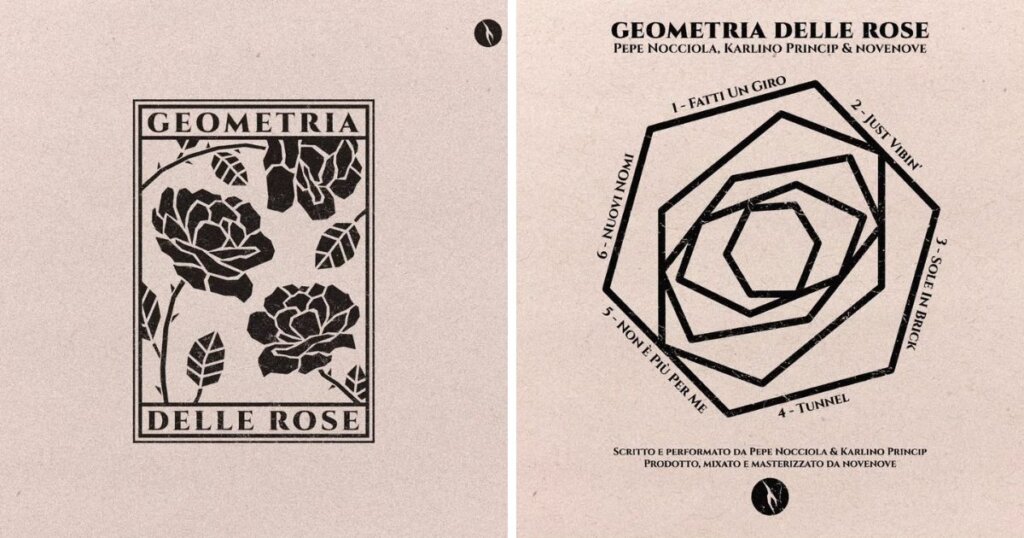
You arrived on the scene like a wellness slogan machine: “life is a blessing,” “life is a gift.” What’s behind the catchphrase?
Interesting. This is interesting. “Life is a blessing” then became “life is a gift,” then basically what remained was “life is…” dot dot dot.
I was talking about it yesterday with someone, with brothers, obviously: brother Frediano and brother Federico. This slogan thing comes from atrocious suffering. I’m alive by some miracle, so “life is a gift,” your brother Stefano says.
For me, “life is a gift” means that I enjoy the small things. As Karlino also says: we became heroes of ordinary living. I’m up in the hills, and I enjoy spending seven hours watching a robin puff up its chest. That’s beautiful; life is a gift in that sense.
Everything really is given to you. But the concept behind it is much wider and comes from years and years of suffering, illnesses, things. It’s a lively concept, a chunky one. It sounds banal, Marileno, because “life is a gift” is a very Marilena thing. But you agree with me that life is a gift.
Hip hop was born urban, city-based, in a way. You, instead, tell and live the province, for once, as a conquest more than as a cage. What’s your relationship with that?
Interesting, also because lately this idea of the province has come back strongly. But I’d like to explode the concept even more, because there’s province and province. There’s the province of Milan, there’s the province of Cuneo, and then there are even more scattered towns that make up the whole Italian province. Those are properly hardcore provinces.
It all comes from that lostness of the last few years, when I came back to the village because of force majeure. At first, it was total hate: felt like prison, cage, I needed help. Then it became a hate-love situation. Now it’s unconditional love. It’s beautiful.
“Incredible. Tell me, isn’t life a gift? I just popped a pimple, as a proper Marileno, as if I really am a damn Marileno. Incredible. How are you?”
Pepe Nocciola
The question is: where have you been beyond the village?
That’s the most Marilena thing of all: I’ve been to Cuneo, twenty minutes away. I lived on my own in Cuneo. Never lived abroad. For a while I tortured myself; I told myself: damn, I’m missing this thing, I’ve never lived abroad. Then I understood that I already travel a lot by being alone in San Martino di Busca, up in the hills.
I come from Pluto, another planet. But the village has truly become my strength. This thing is beautiful.
And then hip-hop and rap are children of the historical period we’re living in. With the frenzy, the post-pandemic period, social media, we all slowed down and reinvented ourselves a little. Everything is very fast now, but we human beings can’t go that fast. If you don’t slow down a little, you explode. You crash.
How was Pepe Nocciola born? Before Pepe Nocciola, what was there? The first thing I heard from you was “Bagnetto verde”, and I thought: f*ck, I’m not the only one making random kitchen rhymes. But…what before that?
Before that, there were things here in the province, with G-Farmers, which is a collective that brought together big names from the Cuneo scene. Like La Loggia, you know? Rings a bell? Sei Giovani Prestanti, quite a historic group around here.
Already back then we were starting to do twenty different things. I did my first live with Dave, with NSC, Nuova Stirpe Crew, which basically is a bit of the DNA of G-Farmers and everything else. It was 2002, 2003, 2006, now I don’t remember exactly, but those years.
I’ve always written rhymes like a madman. But coming from deep province, the means were what they were: recording yourself, doing live shows, organising things was a mess, as we all know.
After years and years of random things, and also after various heavy stuff, I said: I’ll make rhymes, I’ll record, let’s go. I’ve been writing rhymes since middle school. But lately, after force majeure things, diagnoses, various stuff, I said: I’m doing this. Done. And so I’m a crazy Marileno.
Is “Bagnetto verde” your first track in history?
Incredible, no. But it’s funny, because it came out like that, randomly.
My favourite track is still “Chi dorme Poco”. I brought that one to a little festival around here, at Condorito, a historic venue in the province. They organised this Sanrito Festival, which happened parallel to Sanremo: a small festival of big songs here in the province.
I took part in the first two years and won the first year, with all the local bands. Not with “Chi dorme poco”, but that track was there. I sang it out of tune like a ciocca, as we say here, like a bell, basically, but I had fun.
Back then I didn’t have heavy insomnia yet. It was a fresh track, very jazzy, fun. It was produced by Alberto Mella, one of the G-Farmers, the one who then spent years in Barcelona and has now come back. “Chi dorme poco” still gets me hyped: I always do it live.
I started a small singing seminar that loosened me up a bit, so now I do it super hyped.
What are your favourite tracks? If you had to choose three Pepe Nocciola tracks for someone who has never heard you?
Fuck. I’d say “Uggiume”, something that came out recently. A quick parenthesis on “Uggiume”: Dave agrees with me that part of his beat pulled all these things out of me. A flow just came out.
I also had some rhymes and verses there, but it was a truly gloomy afternoon. I had learned how to record myself; I had this microphone in my bedroom; I was looking out the window, fog everywhere, and I said: look at this uggiume. This flow came out.
It’s cool because I talk about friends who are not doing well, I talk about my hills, I talk about Busca, and I always talk about this solitude of mine in Busca: forced at first, then, over time, chosen. And that’s it, I’m good like this, at the moment alone like a dog. Which has also become a tag, another motto.
Then “Fascino”, together with Liffe, from Baci da Busca, the latest project. The hook came out like that, for fun, and the verse is really a boom boom boom. I talk about the Avirex aviator, about me wandering through the woods with this Avirex aviator, hopping around partisan trails, reading books.
The Resistance is deeply felt here. We’re very close to Boves, a village tragically known for very heavy events back then. I was happy to bring in Liffe, this kid from Brescia who is currently smashing it with Barra 1. We found a good way to commit to this track together.
Third track: “Chip Chip” with novenove. That one too is really an anthem to my hills, to this infinite and deviant passion that is birdwatching. And then there’s the flea market thing: “chip chip”. Incredible.
This is another peculiarity that, if it were studied at the table, would be impossible to have: birdwatching and vintage apparel.
Mamma mia, yes. Beautiful. There too, in the rhymes, without forcing anything, this stuff is culture. The names of birds, old Italian Eighties brands, the fact of digging through a flea market like a DJ digging through records. It’s beautiful. Continuous inspiration.
The birdwatching thing is also becoming a bit like vintage was at the time: mainstream. Now everyone is starting with the little binoculars. But birdwatching is a bomb. I get seriously obsessed. I think I’ll make a hundred thousand tracks dedicated to the different species of birds.
I made this track about great tits, still on the latest EP, together with Soffi / Sacred Copia, a girl who is in cahoots with the Superfluido collective from Rome. Listening back to these tracks I think: nice project, but there are too few bird sounds. Too few.
I also bought the whistlebird, those little whistles to make the sounds even better, the ones original birdwatchers use in UK parks. They put this little paper whistle in their mouth, with a reed — what the fuck is that oboe thing called — and it makes incredible sounds. Complex to use, but you buy them on Temu for a few cents. I’m buying bags of them. I really need to have fun with this.
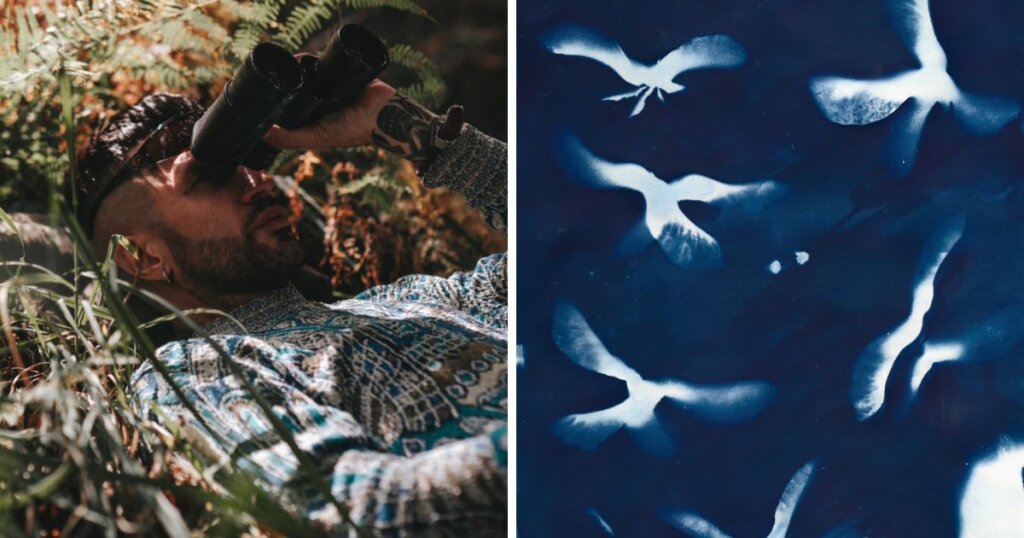
What’s the goal?
The goal is to try to feel a little better. And to go to the theatre. Basically, I’d like to do real performances: me with a pointer explaining what a redwing is.
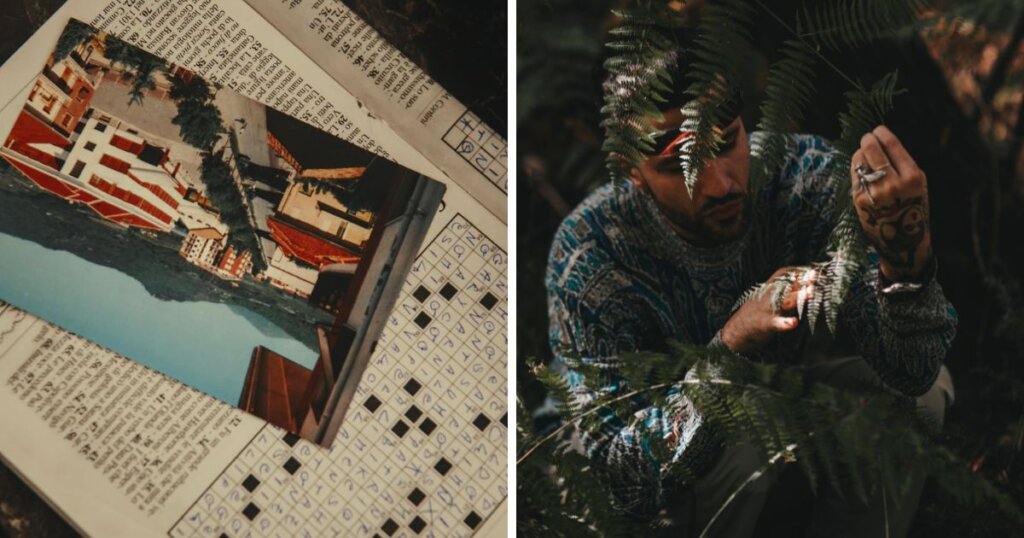
At the last live I did here, I had postcards of Busca projected behind me. Between one track and the next I’d catch my breath, turn around, there was this huge postcard, and I’d point: I wrote this song there, there’s the hermitage of Busca, there’s the little church of San Martino that inspired “Uggiume”.
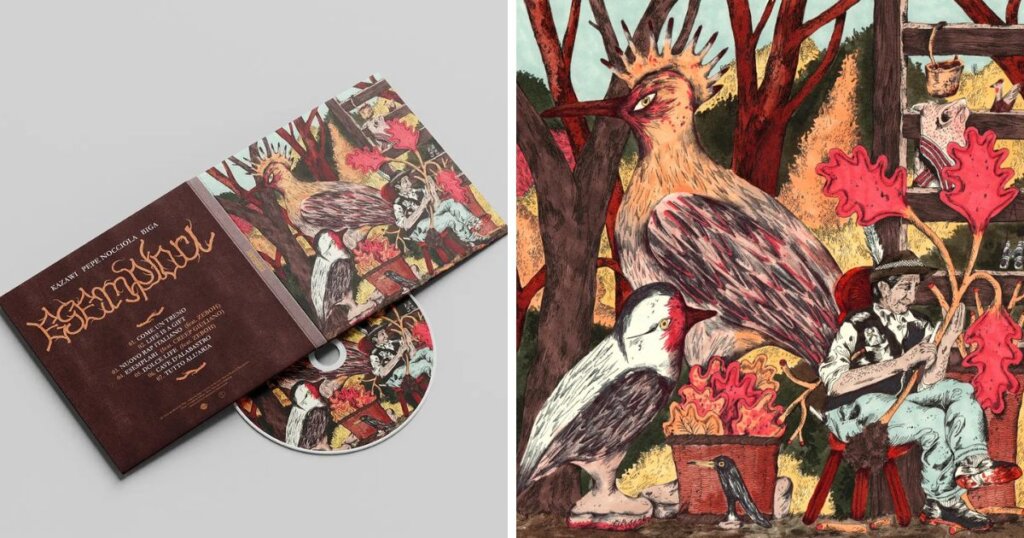
Meanwhile I give you chocolates and explain that the wrapper was designed by my brother Mozebo down in Lecce, who also made the album cover. We’re never getting out of this, brother.
In absolute terms, there isn’t one huge goal. The goal is to keep strongly trying to feel better and better. It’s healthy selfishness: I do it for myself first. But then I end up doing things that I can see also make other people feel good.
I carry a lot of messages; I have a lot to say. There are no very long-term goals. Let’s go. I’m super hyped, genuinely euphoric.
If I ask you about Nocciola’s inspirations, apart from birds, the hills, pastry shops?
Pastry shops, sure. In general, I read a lot, I go to exhibitions, I go to the cinema, a lot of arthouse cinema. I’m always around, when my health allows it.
The basic inspiration is being among people. I’m a simple Marileno, so I prefer being on my own up in the hills, but I move around like crazy when I can. Inspiration is everything.
In terms of rappers, the first records: Guru with Jazzmatazz, the various Jazzmatazz records. I was twelve when Gang Starr’s The Ownerz came out, which was actually included with a subscription to Groove, the magazine. I find Guru again and I’m like: let’s go.
Then all the Enna, all the Native Tongues, De La Soul non-stop. Lately I also listen to American kids who I think might not even be eighteen. I listen to everything. Like this collective around Al.Divino, Feed Family, we’re also in cahoots.
I listen to a ton of Earl Sweatshirt, Rome Streetz, Boldy James, this protégé of Roc Marci. There are loads of cool things. I listen to them and maybe I don’t even understand what the metric is, but I let myself go in the listening, just like I then let myself go in the rhymes.
I also listen to a lot of young girls who sing. I really like Samara Cyn, an incredible American girl who sings and dances. Then Pink Siifu, loads of experimental stuff. I listen to dub music, original dubstep, the proper guttural one, a lot of bass music. Look, I listen to so much stuff that we’d have to go on Spotify and YouTube.
If I had to ask you what question you would never want to be asked?
Things related to family. On a small scale, doing podcasts, interviews and things quite often, maybe questions about the family nest. Those are things I think I wouldn’t be able to talk about openly or manage well.
I talk a lot about family in the songs; I talk a lot about my incredible mother, another total inspiration. But questions too much about personal history or the family situation would be a sore spot.
Then, truthfully, I’ve also shifted character-wise. This simple Marileno thing: I’m an open book; I talk openly about everything. Lately I’ve noticed I don’t even have that much shame; I answer pretty much everything. It depends a bit on the period. But yes, maybe the sore spot is the family question, private life.
What is the question nobody asks you, but that you would like to receive?
It has to do with this illness, multiple sclerosis, which is devastating. I have a lot to say about this. I’d like to talk a lot about invisible symptoms and also about mental health.
Multiple sclerosis and many neurological and neurodegenerative diseases are starting to be addressed openly. But often what happens is similar to depression and mental health in general: people talk about it so much that it almost becomes normalised.
I’ve heard people say: “Yeah, lots of people have multiple sclerosis.” Fine, let’s talk to those lots of people. Because I’ve always only spoken with people who know someone. It’s not easy to communicate with someone who has received that diagnosis. Maybe now they’re doing well, but to be more or less okay, what did they go through? What did they see? These are things that devastate families.
I’d like to talk about it a lot. I’m starting to do it slowly, in some rhyme here and there. I’d talk about it openly, because it’s something that doesn’t show too much.
People see you fly, fresh, and think: but you’re fine. Then maybe the day before yesterday I did a live show, and the next day I spent the whole day in bed. Not because of one specific relapse, but because it happens.
I’d like to get to a point where people ask me about it, where we talk about this thing. They’re not the usual themes; it’s a heavy thing, but I’m completely fine with it.
What’s one of your days like? A Marileno day.
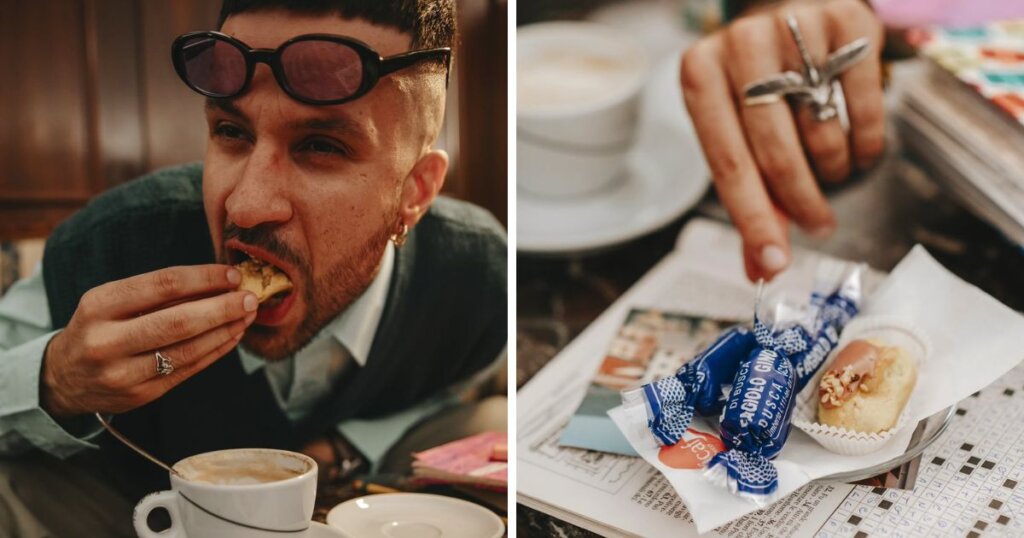
My day is a Marileno day. Basically I go out, get some sun on my face, go to the bar like a good Marileno: cappuccino, coffee, crossword. I read, listen to music, then I eat, have lunch, then I go up into the hills to do birdwatching. I stay in the sun when there is sun.
I listen to the beats Davide sends me, the ones Alberto sends me. I do crosswords, I read a lot, and I spend a lot of time in nature. If I can, I go hiking, also to keep myself physically and mentally active.
In nature, I’m a wild animal. Wild Marileno. I listen to music constantly, compulsively. I read compulsively. I read everywhere: I have five books started, one across my shoulder, two in the car, one on the bedside table and one here in the rehearsal room.
My head is an endless mess, so right now I say: I can only do this thing here. I need to do this thing here, and those books need to be read by me. I’m an anomalous Marileno, an anomalous rapper, because I chose to do this full time in Busca. And I like it.
Who are your favourite authors?
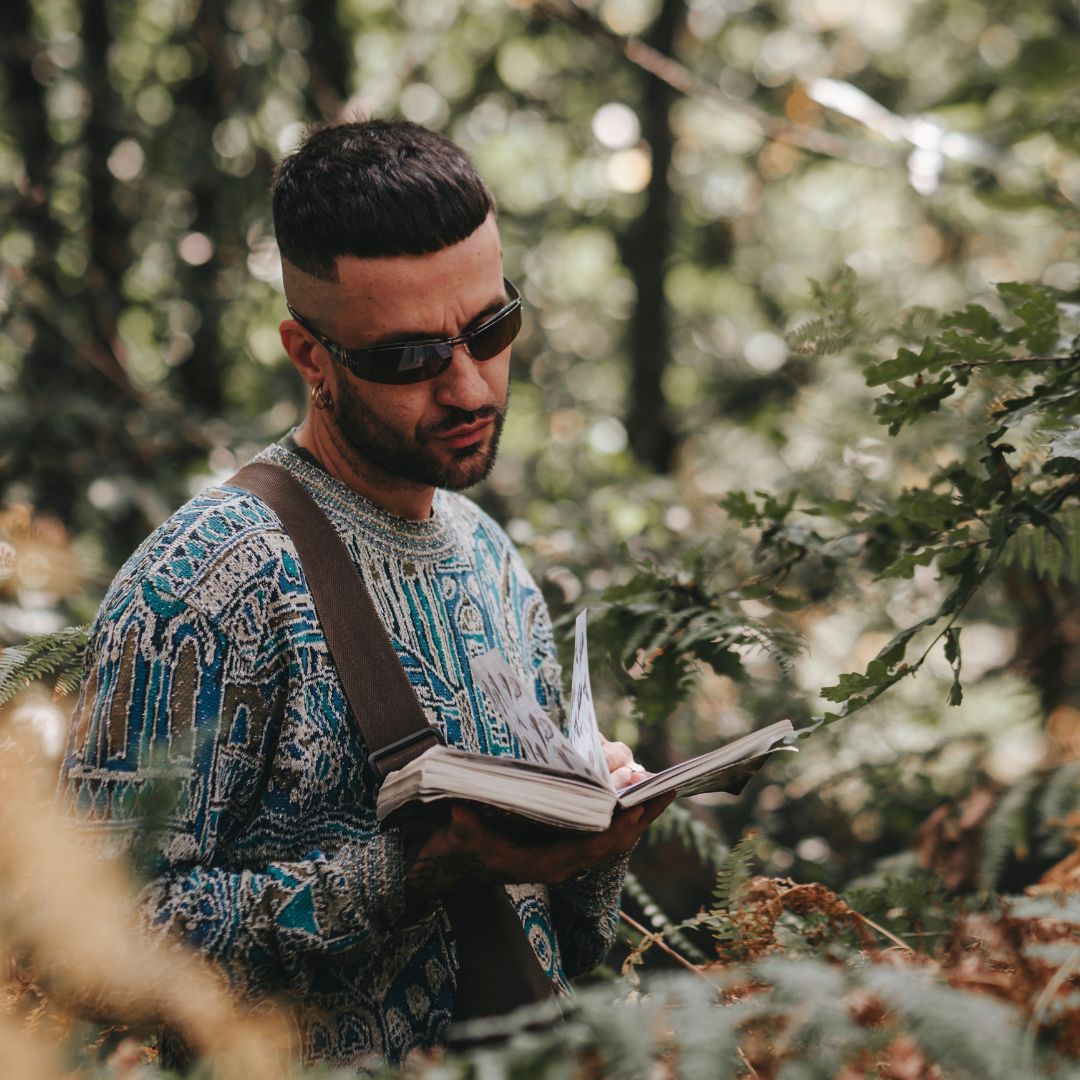
I read a lot of ecological novels, nature writing. I’m completely captivated by that stuff. I always carry Walden; or, Life in the Woods by Henry David Thoreau with me, like a priest’s breviary. That book switched something in me. I read it during a hardcore period, so that thing of going off to lose yourself in the woods and looking at everything from outside is what, in my own small way, I do every day. This thing is incredible.
What would you like to remain with those who listen to your music?
Postcards. That’s it, postcards. I’d like someone to be able to listen back to it with a smile, like when you look at an old postcard of Busca. Those aged postcards, with those beautifully saturated colors.
You listen to a Pepe Nocciola track and you say: look, there’s Busca. I’d like to leave warm postcards.
Let’s talk about present projects. Are you taking Baci da Busca around?
Yes, Baci da Busca. Actually, tonight a track came out with Seife, an incredible producer from Milan, also a little Cuneo-ish and Marileno at heart, with his whole crew, Gato Tomato Click. I’m a little in cahoots with these guys.
Then I have loads of records basically already recorded, and I’m recording a ton of things. Since I learned how to record myself, everything has been flying: I bought myself an entry-level little microphone, sound card, and free software, but it’s going well like this. Everything I’ve recorded, I recorded like this.
Projects are coming soon, loads of featuring. There’s plenty. I hope to keep going forever with G-Farmerz. We’re obviously always in cahoots with Kiazza Mob and Superfluido. That’s why life is a grandono.
Among everyone, new pairs are being born: I’ll make the record with that one, he makes tracks with that other one, we make a posse track. It’s interesting. We found each other among collectives. And obviously there is the stuff with Karlino, my brother forever, alongside novenove. I have also published a duo with Biga and Zakawi, go check it!
Close with a message to the nation. Give me an unreleased slogan, but not “life is a gift.” I want that one only for SB.
An unreleased slogan… okay, it’s always my nonsense. Lately I had come up with “e che yei,” but without Davide it doesn’t work, Davide is from G-Farmers.
“Life is a blessing,” “life is a gift” are more like payoffs than slogans. But we want a new one. We want it only for SB.
Okay, like this, really banal: “life is a chocolate.” Of course, I’m the rapper from the hills.
Or: “The hills of Busca have eyes.” I see you. Like the film, comma, I see you. So let’s feel nicely observed, because rappers are everywhere. They observe, they look at you. I’m up in the hills, and the hills are pretty wide. I also like imagining people down in Busca knowing that I’m up there, in the hills, watching and writing about them too.
I write in the hills in quite a crazy way. I go up into the hills, and I come back down with at least one verse. Otherwise I don’t come back. I stay up there until it gets dark; I stay in the cold.
If someone sees me, they see me right there among the ferns: writing on very earthy beats; I go with flows, and then I mix them, spread them out.